Why Plants are Important For Our Health?
Do you know, plants also give many benefits to our health? As for how plants benefit our mental health, it is also work as a medicine for humans. It's called "Herbs."
Herbs and Their Benefits to Humans
Herbs can be used as a flavoring ingredient in cooking and used for medical purposes, mostly traditional medicine. Traditional medicinal methods using herbs are not only available in this country, but this practice is also practiced all over the world according to their respective cultures.
There is no way to know precisely how the earliest cultures used herbs, but they have taken thousands of years to experiment with the use of herbs. Early cultures and civilizations may have identified that individual plants had healing powers, and these healing powers were due to supernatural causes. The 60,000-year-old burial site in Iraq contains evidence that there are eight different medicinal plants, which may be intended to be brought together into the afterlife. Naturally, herbal medicines have remained in magic and superstition for thousands of years in human civilization.
History of the use of plants and herbs for medicinal purposes
The Chinese, Indians, Egyptians, Babylonians, and natives of ancient America were all herbalists. The longest-known medicinal herbs list is Shen Nung's Pen Ts'ao or Shennong Ben Cao Jing (around 3000 BC), which is probably an arrangement of Chinese herbs for older Chinese oral traditions.
By 3500 BC, the Ancient Egyptians began to associate less with magic for the treatment of disease, and around 2700 BC, the Chinese started to use herbs for a more scientific purpose. The Greek physician Hippocrates (460 - 377 BC), the Hippocratic Oath founder, developed the diagnosis and prognosis system using herbs. He considered the disease to be a natural phenomenon, not caused by intangible factors, and he believed the should give the medicine without magic involvement. In 77 AD, Pliny the Elder wrote 37 volumes of books relating to the history of nature and devoted seven works of it to the use of plants for medicinal purposes. However, Pliny only confirms little of the authenticity of what he wrote, and much of his work is in question today.
Based on Inoue, Hayashi, and Craker(2019) stated that the use of herbs also known by The ancient Romans. Surgeons who traveled with the Roman army spread their herbal expertise throughout the Roman empire, Spain, Germany, France, and England. Dioscorides and Galen, both Greek surgeons in the Roman army, have compiled a list of herbs that remain as agreed medical texts for 1500 years.
References
Inoue, M., Hayashi, S., & Craker, L. (2019, February 04). Role of Medicinal and Aromatic Plants: Past, Present, and Future. Retrieved November 30, 2020, from https://www.intechopen.com/books/pharmacognosy-medicinal-plants/role-of-medicinal-and-aromatic-plants-past-present-and-future
Herbs That Contain Medicinal Value
Saga Root
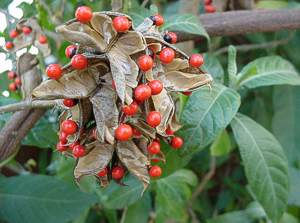
Rosary Pea, Crab's Eye, Crab's Bean, Gunja and Ratti are also identified. It is a kind of plant surrounding trees and shrubs. It's a type of long-blown legume. It is also known in Sanskrit as Gunja and in Hindi as Indian and Ratti. This herb is renowned for its seeds, which are often used for their abrin content as beads and poisonous. This plant is native to Indonesia and cultivates in the tropics and subtropics in which it was developed. The location in which it was introduced appears to be a weed and invasive species. When opened the seed pod is curly, and the seeds inside it are released. According to Chauhan(2019), The seeds processed are flat and are 1,5 to 2 cm long. Its origins are used for the treatment of gonorrhea and jaundice. The oil extracted from the seeds is said to promote the growth of human hair. These seeds are used as a contraceptive to treat diabetes and chronic nephritis.
References: Chauhan, D. (2019, May 06). Rosary Pea (Abrus precatorius) - Uses, Benefits, Dosage and Properties. Retrieved November 20, 2020, from https://www.planetayurveda.com/library/abrus-precatorius-rosary-pea/